



What is Data Harmonization? (And Why Your Business Needs It)
by Fabien Rivenet
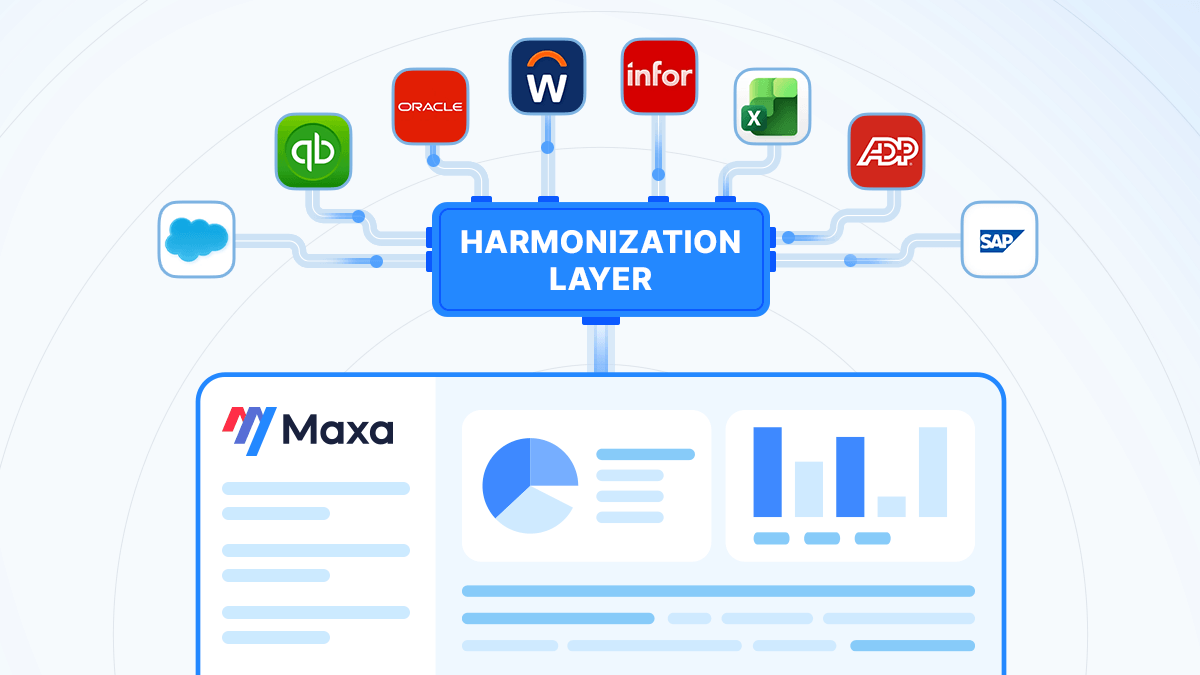
When two enterprise systems define a key metric differently – whether it’s gross margin, revenue, or inventory – confidence wavers, and hours are wasted reconciling the data. But conflicting metrics are only part of the problem. When core data entities like customers, products, and locations aren’t standardized across systems, even well-defined metrics become unreliable because there’s no consistent foundation to aggregate them against. Multiply both issues across your operational systems, and it’s clear how quickly fragmented data can slow down your entire organization.
This is a common challenge for businesses operating across multiple ERPs, finance, and operational systems, where each system captures and defines data in its own way. The result is conflicting numbers, duplicated effort, and a constant struggle to produce information stakeholders can trust and act on with confidence.
With data harmonization, organizations can standardize both their core data entities and their metric definitions into a consistent, comparable format. It aligns the building blocks your business runs on (customers, products, locations) alongside the rules and calculations used to measure performance, so all systems speak the same language and create a reliable foundation for reporting, analytics, and decision-making.
Let’s examine how data harmonization works, the problems it solves, and how it can turn fragmented systems into a reliable source of insight for your business.
What does it mean to harmonize data?
Data harmonization is the process of bringing together information from multiple systems and sources and making it consistent, comparable, and reliable. It operates across two dimensions that work together to create trustworthy data.
The first is master data harmonization: standardizing the core entities your business tracks across systems, such as customers, products, suppliers, and locations. When the same customer is recorded differently across your CRM, ERP, and finance system, or when a product category means something different in each platform, your aggregation points break down. Business users rely on these entities to roll up and accurately interpret metrics. Without consistent master data, you can’t meaningfully compare revenue by customer, margin by product line, or performance by region, because each system is grouping and labeling things differently.
The second is business rule and metric harmonization: standardizing how metrics and KPIs are defined and calculated across the organization. Revenue recognition, gross margin, inventory counts, and operational KPIs often follow different formulas in different systems. Harmonizing business rules ensures that every system uses the same logic, so the numbers your teams are looking at are actually measuring the same thing.
True harmonization requires both. Harmonized master data creates the consistent aggregation points that give metrics context and meaning. Harmonized business rules ensure those metrics are calculated the same way everywhere. Together, they produce a single, trusted view of your data that teams can rely on for reporting, analysis, and decision-making, without spending hours reconciling conflicting numbers or second-guessing whether two reports are even measuring the same thing.
Why data harmonization matters for your business
If your data lives across multiple ERPs, finance, operations, or other systems, you know how frustrating it can be when each system defines metrics differently or when the same customer or product is labeled differently depending on where you look. Conflicting numbers, slow reporting, and hours spent manually reconciling data can make it hard to trust your own reports and slow down decisions that matter.
Without harmonized data, your organization risks inconsistent reporting, misaligned decisions, and operational bottlenecks. Teams spend hours reconciling conflicting numbers, errors slip through dashboards, and analytics outputs can’t be trusted, slowing decisions that impact revenue, efficiency, and overall competitiveness.
The impact goes beyond inefficiency. According to a Validity survey, 44% of organizations lose more than 10% of their annual revenue due to low-quality CRM data.
McKinsey emphasizes that organizations must make data easy to use, track, and trust, which fundamentally depends on integrated and standardized data. Companies that integrate data effectively across systems (and with AI and analytics tools) unlock competitive advantage and new capabilities. In other words, harmonized data is a prerequisite for scaling analytics and AI across the enterprise, because without it, disparate data sources can’t be reliably used for decision-making or automation.
Data harmonization consolidates your data into a single, auditable foundation, so you can be confident that definitions, calculations, and business logic are consistent across every system. So you’ll have a single source of truth that you and your team can trust.
It also sets the foundation for AI readiness. AI tools, like those used in finance, are only as reliable as the data behind them, and harmonized data ensures that when your organization is ready to adopt AI for forecasting, planning, or performance analysis, the inputs are clean, consistent, and trustworthy enough to produce decisions you can act on.
Here’s what that means for you and your business:
- Consolidate your financial, operational, and ERP data into a single, consistent dataset to get reports faster and ensure your numbers are accurate and defensible.
- Eliminate reconciliation headaches by removing conflicting numbers and spreadsheet fixes, so your team can focus on meaningful analysis.
- Establish consistent aggregation points across customers, products, and locations so your teams can roll up and compare metrics with confidence, regardless of the system the data originated in.
- Make confident, data-driven decisions by ensuring everyone works from the same trusted foundation.
- Turn your data into actionable insights by powering dashboards, advanced analytics, and reporting across the tools you already use, from Excel to Power BI or Tableau.
Data harmonization vs data integration
It’s easy to assume that data integration and data harmonization are the same because both involve combining information from multiple systems. The key difference is that integration focuses on bringing data together, while harmonization goes a step further by ensuring that the data is consistent, aligned, and standardized across systems, both in how entities are defined and how metrics are calculated, so it can be trusted for reporting and decision-making.
Here’s a quick breakdown of the differences between the two:

How the data harmonization process works
Every organization’s approach to data harmonization will look slightly different depending on the systems and business rules, but there are some practical steps to get from fragmented data to a single, reliable dataset.
1. Collect data from all sources
Gather information from ERPs, finance systems, operations, and any other relevant systems. Knowing all your sources ensures no data is overlooked.
2. Inventory your master data entries
Identify the core entities, such as customers, products, locations, and suppliers, that appear across multiple systems and document how each is defined, categorized, and labeled in each source. This surfaces inconsistencies that, if left unresolved, will undermine reporting.
3. Compare and align metrics
Identify differences in definitions, calculations, and formats across systems to understand where discrepancies exist.
4. Clean the data
Remove duplicates, correct errors, and standardize formats to prepare data for harmonization.
5. Standardize master data
Establish consistent definitions and categorizations for your core entities before applying business rules. This creates the reliable aggregation points that metric harmonization depends on.
6. Combine and reconcile information
Map related data across systems and reconcile inconsistencies to create a unified dataset.
7. Apply harmonization logic
Standardize business rules, metrics, and calculations so all systems interpret and report data consistently.
8. Review and validate results
Ensure the harmonized dataset is accurate, complete, and reliable for analysis and reporting.
9. Update and refine continuously
Adjust mappings, rules, and processes as systems evolve or new sources are added, keeping the dataset actionable over time. Harmonization rules, both for master data and business logic, often build on one another, compounding value as your data environment matures.
Data harmonization best practices
There are some key best practices that can make your data harmonization efforts more reliable, auditable, and flexible. They help you align your systems, keep data clean and consistent, and build processes that can scale as your business grows.
Address master data before business rules
Standardizing your core entities first gives your business rules a consistent foundation to operate against. Trying to harmonize metrics across inconsistently defined customers, products, or locations produces results that are hard to interpret and harder to trust.
Define clear metrics and rules
Agree on consistent definitions, calculations, and business logic across all systems to prevent confusion and errors.
Automate wherever possible
Use data harmonization solutions like Maxa to automatically apply business logic, reduce manual work and potential errors, and maintain audit trails.
Maintain traceability and auditability
Keep a record of transformations and data lineage to support compliance and ensure results are defensible.
Focus on data quality
Clean, validate, and standardize data before harmonization to minimize errors and improve reliability.
Design for scalability and flexibility
Ensure your data harmonization process can accommodate new systems, acquisitions, or organizational changes without a complete overhaul.
Monitor and improve continuously
Regularly review mappings, rules, and data quality to adapt to evolving systems and business needs, keeping your dataset reliable over time.
Data harmonization in action
Here are some ways organizations use harmonized data, across both master data and business rules, to drive real results:
- Consolidating financial reporting across multiple ERPs, bringing together revenue, margin, and cost data from different systems to create faster and more accurate reports.
- Teams align margin calculations across regions, departments, or product lines to ensure profitability metrics are consistent and comparable, supporting strategic decision-making.
- Operational KPIs are tracked across multiple systems, allowing leaders to monitor work order efficiency, inventory levels, and other key metrics without manual reconciliation.
- Harmonized data powers dashboards and analytics tools, feeding information into Excel, Power BI, Tableau, or other platforms so teams can access quick, actionable insights.
Transform fragmented systems into insights you can trust with Maxa

Maxa’s data harmonization solutions help you turn data from multiple ERPs, finance, operations, and other systems into a unified, reliable foundation for your business. By harmonizing both your core data entities and your business rules across all systems, Maxa ensures your numbers are consistent, auditable, and ready for fast, actionable analysis.
With Maxa, your team can eliminate time-consuming reconciliation, accelerate reporting and analysis, and make confident, data-driven decisions without second-guessing the numbers. It allows departments to work from the same aligned datasets, improves collaboration, and supports advanced analytics across tools like Excel, Power BI, or Tableau, all while keeping your data secure and under your control.
Contact us to see how Maxa can transform your data into a reliable, auditable foundation for smarter business decisions.